Top ranking that reflects long-term dynamics
Produced by Arthur Loyd, France’s leading commercial real estate advisory network, this annual ranking is based on 75 indicators grouped into four major categories (economic vitality, business environment & commercial real estate, connectivity & human assets, and quality of life). The ranking serves as a recognized, in-depth analytical tool to guide relocation and investment decisions.
With a population of over 520,000, the Montpellier Métropole area ranks first in three of the four categories:
- 1st for economic vitality
- 1st for business-friendliness and commercial real estate
- 1st for connectivity, human assets, and transitions
Reaching the top spot among major French metropolitan areas in the Arthur Loyd 2026 Barometer, Montpellier confirms its status as a driving force, capable of combining economic attractiveness, transitions, and human assets. This recognition enhances the region’s exposure among entrepreneurs, investors, and project leaders, and is part of a long-term strategy.
Montpellier takes the lead in terms of economic vitality
The barometer highlights the area’s economic performance, which ranks first in the “Economic Vitality” category among major French metropolises.
This result is driven by the area’s:
- Dynamic job market
- High percentage of senior managers
- High rate of business creation
Arthur Loyd also highlights the area’s specialization in “Advanced Metropolitan Activities” and its strategic positioning in future-oriented sectors:
- Cultural and Creative Industries, along with the presence of many renowned schools and studios in the area, such as Ubisoft, ARTFX, and Sandfall Interactive (which won nine awards at the 2025 Game Awards for its game “Clair Obscur: Expedition 33”), Illogic Studios (which created Intermarché’s “Unloved Wolf” commercial), and France.tv in Vendargues. A veritable hub for film production, the metropolitan area hosts over 1,000 days of filming annually.
- Healthcare, via the MedVallée Montpellier initiative, whose goal is to make Montpellier a center of excellence in global health (One Health).
- Renewable energy, which accounts for 4,500 jobs locally.
Proven capacity for commercial real estate
Another clearly identified strength is the metropolitan area’s ability to meet business needs for commercial real estate. Montpellier ranks first for commercial real estate market performance in its category.
The study highlights the fact that 2024 was very dynamic in terms of office space placement, with flagship projects such as:
- Montpellier Business School campus (28,000 m²)
- The establishment of Engie (4,000 m²) in the Cambacérès district
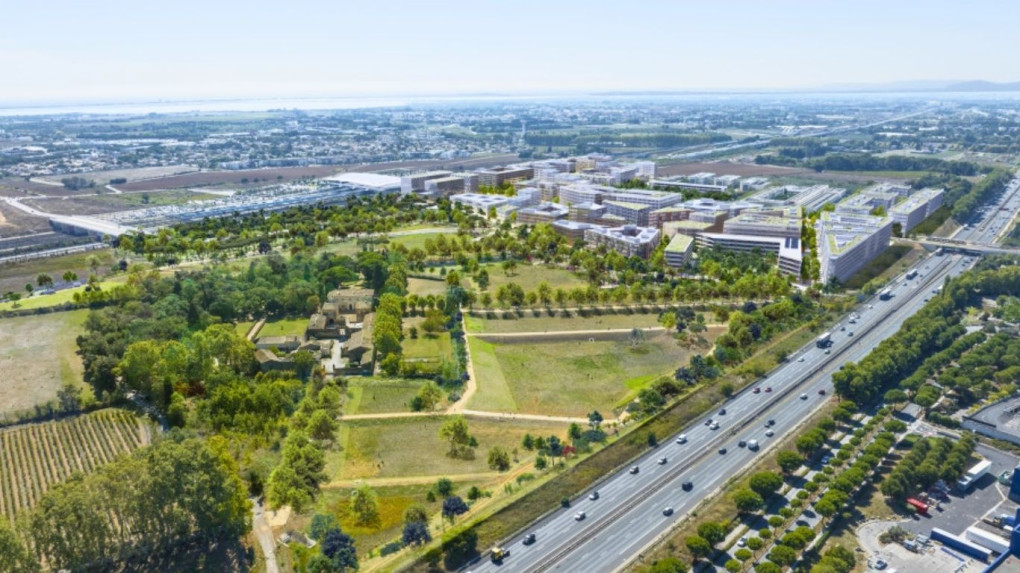
Now fully connected thanks to the extension of tramway lines linking the Sud de France train station to downtown Montpellier, the Cambacérès business district provides over 400,000 m² of floor space at the city’s southern entrance. 70 companies are already based there, including 28 assisted and hosted at Halle de l’Innovation facility. Exemplary and responsible, it is also committed to energy and ecological transitions, as demonstrated by the first groundwater geothermal power plant, which will provide electricity for 450,000 m².
Human assets, connectivity, and transitions: a key advantage
Montpellier also holds first place in the “Connectivity, Human Assets, and Transitions” category, thanks to:
- Exceptional demographic growth, particularly among young people and higher education graduates
- Good national and international access, with two high-speed TGV train stations and an international airport
- An ability to foster investment projects in transition-related sectors, including renewable energy and carbon-free mobility
“The Languedoc capital is impressive for its demographic vitality and its ability to attract people, particularly young people,” notes Arthur Loyd.
Identified challenges, in line with its attractiveness
As the study indicates, this appeal also has its downsides. Montpellier ranks lower in the “Quality of Life” category, particularly due to:
- High housing costs
- Environmental vulnerabilities (climate risks, air quality), common to many attractive cities in southern France
These vulnerabilities are clearly identified as priority areas for action, notably through policies aimed at reducing the cost of living and developing accessible mobility solutions, including free public transportation, which has already been implemented at the metropolitan level.
Beyond economic performance, Montpellier Méditerranée Métropole advocates for a balanced and responsible approach to attractiveness, focused on attracting value-creating businesses while preserving and enhancing residents’ quality of life, the region’s identity, and its commitment to ecological and social transitions.